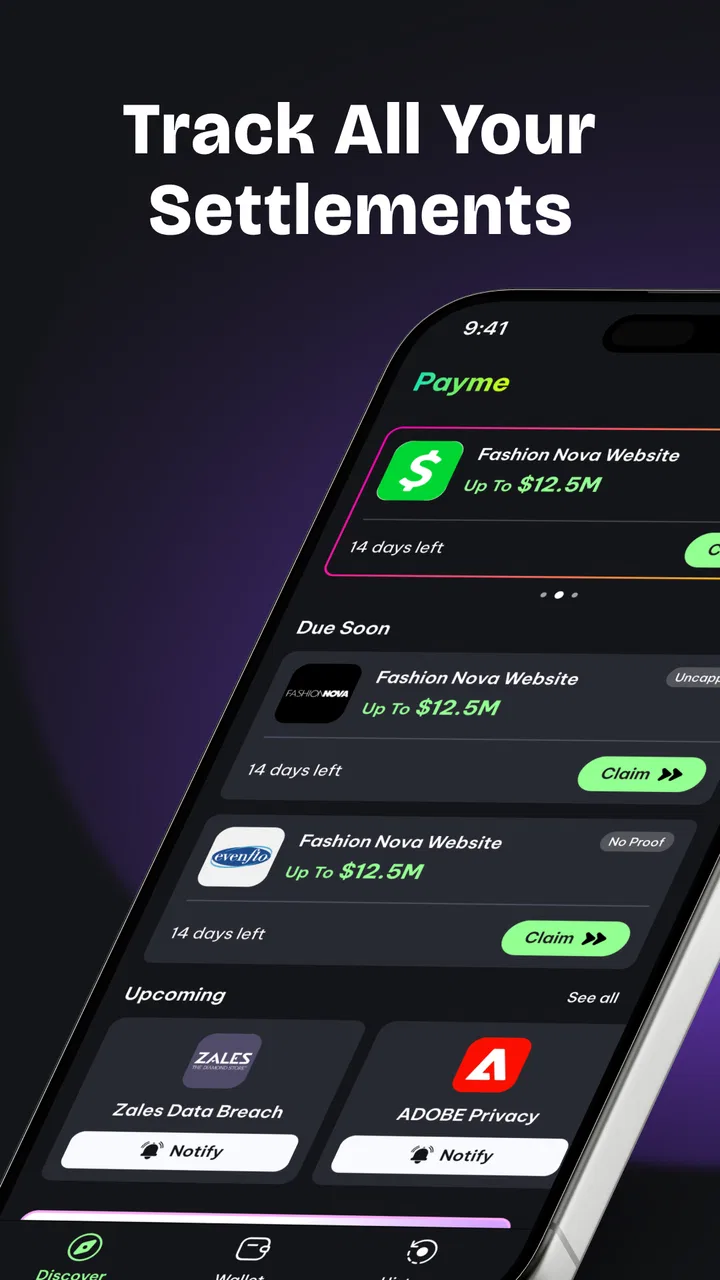
Payme: Class Action Payout
- 3.0
- Rating
- 50.00K
- Installs
- Free
- Price

 Analysis by App-foxy
Payme: Class Action Payout is a finance app built around a simple but potentially useful idea: helping people submit class-action settlement claims and keep an eye on the money that may follow. I found it most interesting as an organizational tool rather than a way to discover instant cash. Its value depends heavily on whether you already have a settlement you can legitimately claim, how carefully you complete the information requested, and how much patience you have while the process moves forward.
That distinction matters. The app’s promise is not the same as a normal banking app, budgeting tool, or payment wallet. It is aimed at the paperwork and follow-up side of settlement claims. GAMEPEAK LIMITED is the developer, and the app is free to install, although purchases are available from $7.99 to $14.99 per item. I would approach it with a practical mindset: use it to organize a claim, not as a guaranteed source of income.
What using Payme feels like in practice
I’ll focus on the parts of the experience that matter after opening the app: how to keep a claim organized, what to double-check before submitting, and how to avoid treating a pending payout as money already earned. The key question is whether a dedicated workflow makes your records easier to manage than the simple alternatives.
You May Also Like

 Blood Strike: 2.5 Anniversary
Blood Strike’s Loadouts Turn Every Drop Into a Tactical Gamble
A close look at Blood Strike’s custom loadouts: how fast access to signature weapons reshapes its battle royale rhythm, rewards preparation, and narrows the gap between fights.

 Pandora - Music & Podcasts
Pandora’s Music Is Easy to Start, but Harder to Recover
Pandora’s strength is its low-effort path from a seed to a station. Its weak spot is how much confidence it asks you to place in connection, setup, and quiet recovery.

 8 Ball Pool
 Is Built on Rivalries, Rematches, and Routine
A close look at the rivalries, rematches, shared routines, and unanswered safety questions that turn a quick pool match into a persistent mobile community.

 Samsung Music
’s Quiet Strength Is Playing What You Already Own
Its reach comes less from spectacle than from dependable access to a personal library. That simplicity is both the app’s strongest retention engine and its ceiling.

 AccuWeather: Weather Radar
AccuWeather Review: A Quick, Clear Forecast for Everyday Decisions
For everyday plans, the best forecast is the one you can understand quickly. AccuWeather makes rain timing, radar, and local conditions easy to act on, with a few trade-offs.

 Hill Climb Racing
Why Hill Climb Racing Still Turns Crashes Into One More Run
A tiny car, a bumpy hill and one more upgrade: Hill Climb Racing keeps resurfacing because its simple chaos makes every near-miss feel personal.
More From Our News Desk



A focused tool for settlement paperwork
The first strength is focus. Instead of mixing claim-related tasks with spending charts, transfers, credit monitoring, or investment screens, Payme: Class Action Payout centers its purpose on claims and payouts. That makes the concept easy to understand. If I receive a settlement notice and want one place to work through the submission and later check its progress, a dedicated app can feel less scattered than relying on email searches, browser tabs, screenshots, and calendar reminders.
The store summary emphasizes submitting claims, tracking payouts, and pursuing payment. In everyday use, those are three separate jobs, and treating them separately is important. Submission is about entering accurate information before a deadline. Tracking is about retaining a clear record after submission. Payment follow-up is about understanding whether a claim is still being processed or whether further action is needed. A good workflow should prevent me from assuming that completing the first step means the money is already on its way.
My strongest recommendation is to prepare before opening a claim form. I would first gather the relevant notice, dates, account details, purchase records, or other documentation mentioned in the settlement instructions. Then I would compare every field in the app with the original notice rather than relying on memory. This small habit is more valuable than rushing through a polished interface, because an incorrect name, address, account detail, or eligibility answer can create trouble later.
The most useful workflow is the one after submission
Many people think the important moment is pressing “submit.” I see the tracking stage as just as important. After submitting a claim, I would save the confirmation information, note the settlement name, and record any reference details in a separate secure place. I would also make a reminder to check the status later instead of repeatedly opening the app every day. This turns Payme into a lightweight case-management tool rather than a source of constant uncertainty.
A practical scenario would be a person who receives several settlement notices over the year. One claim may involve a purchase, another may involve a service subscription, and a third may require a different eligibility explanation. Keeping each claim’s deadline, submission status, and expected follow-up separate can reduce the chance of submitting the same claim twice or forgetting which evidence belonged to which case. The app is most helpful when I use it as a record of actions already taken, not as a replacement for reading the official settlement terms.
There is also a useful mental separation between eligibility and convenience. An app can make a form easier to complete, but it cannot turn an ineligible person into an eligible claimant. I would never select an answer simply because it appears likely to produce a payout. The safest approach is to answer from the facts and documents I actually have. That is especially important for finance-related tools, where a fast workflow can tempt users to treat a legal declaration like an ordinary survey.
Where the app can save time
Payme has a reasonable place in the routine of someone who dislikes administrative follow-up. The benefit is not necessarily that each individual claim becomes dramatically faster. The benefit is that the process can become easier to remember and revisit. A dedicated place for claims may be more convenient than hunting through old messages or trying to reconstruct what happened weeks earlier.
I also like the idea of using it at a fixed time rather than whenever a notification or rumor appears. For example, I might review open claims once a week, confirm whether any action is needed, and then close the app. This avoids turning a possible payout into a daily distraction. It also encourages realistic expectations: settlement administration often involves waiting, and checking more frequently does not usually make the process move faster.
Another non-obvious advantage is the possibility of reducing duplicate effort. If I start a claim on one device, continue later, and keep the process organized in one dedicated place, I am less likely to begin again from scratch. That is particularly useful for people managing claims for a household, provided they keep each person’s information clearly separated and do not casually mix records.
Important limits before you rely on it
The average rating is 3.0 from around a hundred ratings, with several dozen written reviews. I read that as a reason to keep expectations measured. It does not automatically mean the app is unusable, but it suggests that the experience may not be equally smooth for everyone. A finance app dealing with claims needs more than a convincing concept; it needs clarity, dependable status information, and careful handling of user input.
The app is also marked for Teen users. That makes it accessible to a relatively broad audience, but an age label should not be confused with financial or legal guidance. A younger user may still need help understanding eligibility language, documentation, and the consequences of submitting a claim. I would involve a trusted adult whenever a settlement form asks for information that the user does not fully understand.
The free installation is appealing, but the in-app purchase range deserves attention. I would not pay for an upgrade merely because I hoped it would produce a larger settlement or guarantee faster payment. A purchase can only be worthwhile if its function is clearly explained and it offers a convenience I genuinely need. Before spending, I would ask myself whether I can complete and track the claim without it, and whether the expected benefit is worth the cost.
This is where Payme differs from ordinary alternatives. A browser and a spreadsheet may be enough for someone who handles only one or two claims. An email folder can preserve notices and confirmations without adding another account or app. Official settlement websites may be the better choice when I want to verify the administrator’s instructions directly. On the other hand, a person who wants a more focused mobile workflow may prefer Payme over manually maintaining a spreadsheet.
How I would verify a claim
I would treat the app as a convenience layer, not the final authority. Before entering sensitive information, I would compare the settlement name, eligibility rules, deadline, and contact details with the original notice or official settlement materials. If the wording inside the app differs from the official instructions, I would pause and resolve that difference before continuing.
I would also be cautious with requests for payment information. A legitimate payout process may require details for delivery, but that does not mean every request should be accepted without thought. I would check why the information is needed, whether it matches the settlement’s instructions, and whether the destination is correct. I would avoid sending extra documents simply because an upload option is available.
Keeping a personal audit trail is another strong tip. I would save the submission date, confirmation screen, and any messages connected to the claim. If the app later shows a status that is unclear, those records give me something concrete to compare. They also help if I need to contact the relevant administrator through an official channel rather than relying only on an in-app status label.
Who will get the most from it
I think Payme is best suited to people who regularly encounter settlement notices and want a dedicated place to manage them. It may also suit users who are comfortable completing forms on a phone but tend to lose track of deadlines, confirmation numbers, or the status of older submissions. For these users, the app’s narrow focus is an advantage.
It could be useful for someone who has limited administrative time. A parent, freelancer, or busy household manager may not want to build a full spreadsheet for modest claims. A focused mobile workflow can make the task feel more manageable, especially when the user sets a schedule for checking progress and keeps supporting records outside the app.
I would be more cautious recommending it to someone who expects guaranteed earnings, instant transfers, or automatic eligibility. Settlement payouts are conditional, and the app cannot change the underlying terms of a case. Users who prefer maximum control may be happier working directly through official settlement portals and keeping their own records. That approach can take more effort, but it reduces dependence on an intermediary interface.
It is also not my first choice for someone who is uncomfortable entering personal or financial information into a third-party finance app. That person should read the app’s on-screen explanations carefully and decide whether the convenience justifies the trust involved. If the process feels unclear at any point, stopping and using the official claim route is the sensible alternative.
Device support and the current release
The app supports Android devices running version 7.0 or later, which covers a wide range of older phones as well as newer models. The current version is 1.0.20, so I would keep expectations realistic about polish and maturity. A relatively early release can improve over time, but users should still pay attention to whether the workflow feels stable on their particular device.
Because this is a finance app, I would update it through the normal app-store process and avoid installing altered copies from unknown sources. I would also use a screen lock on the phone and avoid completing sensitive forms on an unsecured public network. Those habits are not glamorous, but they matter more here than visual design.
The app has passed the threshold of over fifty thousand installs, which indicates that it has attracted meaningful interest. Still, that number alone does not tell me whether it will handle every settlement scenario well. I would judge it by the specific claim I need to manage, the clarity of its instructions, and how easy it is to preserve a record of what I submitted.
My balanced take on the payment promise
The phrase “make them pay” creates a strong expectation, but I would interpret the app more carefully. Tracking a payout is not the same as forcing an administrator to release money, and submitting a claim is not the same as being approved. The app may help me stay organized and notice when a follow-up is appropriate, but it cannot remove the legal and administrative conditions attached to a settlement.
That is the central trade-off. Payme may be more convenient than handling everything manually, yet convenience can make a complicated process look simpler than it really is. I would use the app for reminders, records, and a guided workflow while continuing to read the underlying settlement terms. If the app’s presentation ever conflicts with those terms, the terms should win.
I also would not use a possible payout as part of my monthly budget. Until money has actually arrived and cleared, it is only a possibility. This is a small but important financial habit: treat settlement proceeds as unexpected money, not as income that can cover rent, debt payments, or planned purchases.
Verdict: useful for organization, not a shortcut to compensation
After weighing the focused purpose against the uncertainty around claims and the mixed rating, I see Payme: Class Action Payout as a potentially handy organizer for a specific audience. I like its straightforward role in bringing submission and payout tracking into one mobile experience. I also appreciate that it can encourage a more disciplined claim workflow when paired with saved confirmations, careful eligibility checks, and scheduled follow-up.
My recommendation is conditional. If I already have legitimate settlement opportunities and want a dedicated way to manage them, I would consider trying the free version first and judging whether it genuinely reduces my administrative work. I would avoid paying for optional items until I understand exactly what they add. If I only have one claim, prefer direct official websites, or feel uneasy about sharing sensitive details, the usual browser-and-records approach may be better.
Payme is most convincing as a claim organizer, not as a promise of easy money. Used with realistic expectations, it may help turn scattered notices and forgotten follow-ups into a clearer routine. Used as a guaranteed payout machine, it is likely to disappoint. That difference is the key to deciding whether this finance app belongs on your phone.
FAQs for Payme: Class Action Payout
01What is Payme: Class Action Payout?
Payme: Class Action Payout is an app designed to help users discover and manage eligible class action settlement payments. Depending on the case, the app may provide information about available settlements, eligibility requirements, claim deadlines, and payment status. Before using it, carefully review each settlement’s official terms because the app does not guarantee that every user qualifies or will receive money.
02How does Payme: Class Action Payout work?
After installing the app, users can typically review listed class action cases and provide information needed to check potential eligibility or track a claim. The exact process may vary by settlement and could involve completing an official claim form, confirming personal details, or following instructions from the appointed administrator. Always verify the case through its official website before submitting sensitive information.
03Is Payme: Class Action Payout legitimate and safe to use?
Users should treat Payme: Class Action Payout as an information and claim-assistance tool rather than assuming it is the official administrator for every settlement. Check the developer name, privacy policy, permissions, reviews, and links to official settlement websites before proceeding. Never pay an unexpected fee or share passwords, banking credentials, or unnecessary identity documents to receive a settlement payment.
04Does Payme charge fees or take a percentage of settlement payments?
The cost of using Payme may depend on the app’s current terms and on the specific settlement process. Some class action claims are free to submit, while third-party services may charge fees or retain a portion of a payment for assistance. Read the pricing, service agreement, and settlement instructions carefully before accepting anything, and compare the process with filing directly through the official administrator.
05When will I receive my class action payment through Payme?
Payment timing cannot be guaranteed because it depends on the settlement’s approval, claim review, appeals, fraud checks, and the administrator’s distribution schedule. Even an accepted claim may take weeks or months to pay. Use the official case contact details to confirm your status, and be cautious of messages demanding urgent payment or additional sensitive information before releasing your funds.
Pros
- Simple interface makes payout details easy to review.
- Supports digital delivery
- reducing paperwork and mailing delays.
- Useful payment status updates help track claim progress.
- Available payout methods may suit users who prefer online payments.
- Clear claim-related information can reduce confusion about eligibility.
Cons
- Availability depends on active settlements and eligible class members.
- Some payouts may require identity or claim verification.
- Payment processing can take longer than the app interface suggests.
- Personal and financial information may be required for payment delivery.
- Support options may be limited for complex claim disputes.

Payme: Class Action Payout
Gallery